Triceratops: Facts, Body Features, and What Scientists Know
Everything about Triceratops — its three horns, the bony frill, what it ate, when it lived, how it defended itself, and how scientists figured it all out from bones.
 The Chief Ranger
Triceratops is the dinosaur with three horns and the wide bony frill behind its head. Its name means "three-horned face." It lived during the Late Cretaceous Period, about 68 to 66 million years ago — the same time and place as Tyrannosaurus Rex. This guide covers what scientists know about Triceratops, drawn from museum collections including the Smithsonian, the American Museum of Natural History, and decades of fossil discoveries in western North America.
Quick facts#
- Lived: Late Cretaceous, about 68 to 66 million years ago
- Length: 26 to 30 feet (8 to 9 meters) head to tail
- Height at shoulder: 9 to 10 feet (3 meters)
- Weight: 5 to 9 tons (10,000 to 18,000 pounds)
- Diet: Herbivore (plant-eater)
- Where found: Western North America — Montana, Wyoming, Colorado, South Dakota, Saskatchewan
- Defining features: Three horns, large bony frill, beaked mouth, four legs
What Triceratops looked like#
A massive four-legged herbivore about the size and weight of a modern adult elephant. The body was bulky, the legs thick and column-like to support the weight. The head, though, is what makes Triceratops famous.
The three horns#
- Two long horns above the eyes — about 3 feet long each on adults
- One shorter horn on the snout, above the nose
The horns were made of bone covered in keratin (the same material as your fingernails or a rhino's horn). The keratin coating made them even longer and sharper in life than the fossil bones suggest.
The bony frill#
The frill is a sheet of bone extending up and back from the skull, fanning out behind the head. On a full-grown Triceratops, it was about 7 feet across. It was solid bone — unlike some related ceratopsians whose frills had holes — which is part of why scientists believe it served as both defense and signal.
The beak#
A sharp, hooked beak at the front of the mouth, made for shearing tough vegetation. Behind the beak, hundreds of teeth arranged in rows for grinding plants — Triceratops constantly replaced worn teeth throughout its life.
What it ate#
Pure herbivore. Ferns, cycads, palms, and tough fibrous plants common in the Late Cretaceous floodplains of western North America. The combination of beak (for shearing) and rows of grinding teeth (for processing) handled tough, fibrous vegetation other herbivores could not eat.
A full-grown Triceratops at 5 to 9 tons needed massive amounts of food — likely several hundred pounds of plants per day. They probably moved through their habitats in groups, the way modern bison or elephants do, working through vegetation as they went.
What were the horns and frill for?#
The longest-running debate in Triceratops research. Three competing (and possibly all correct) hypotheses:
1. Defense against predators#
The most intuitive answer. Triceratops lived alongside Tyrannosaurus Rex, and a 5-ton herbivore with 3-foot horns pointed at the predator's face would be a serious problem. Some Triceratops fossils show healed bite marks from T-Rex — meaning the Triceratops survived the encounter. The horns probably did help.
2. Competition within the species#
Modern animals with horns (deer, antelope, bison) often use them in fights with rivals of the same species, not against predators. Triceratops horns and frills may have served the same purpose — males competing for mates, displaying status. Some Triceratops fossils show horn injuries consistent with this kind of fighting.
3. Display and identification#
The frill in particular may have been more about looking impressive than about defense. Bright colors on the frill (which we cannot see in fossils but which related species sometimes show evidence of) would have helped Triceratops recognize their own kind, signal mating readiness, or assert dominance without fighting.
Current scientific consensus: all three functions overlapped. The horns and frill evolved under pressure from predators, intraspecific competition, and sexual selection at the same time. The Smithsonian's paleobiology research has documented this multi-functional adaptation in several ceratopsian species.
Where Triceratops fossils are found#
Western North America, in the same Late Cretaceous rock formations as T-Rex. The Hell Creek Formation in Montana and the Lance Formation in Wyoming have produced the most Triceratops specimens. Over 50 mostly-complete skulls have been catalogued — one of the most thoroughly studied dinosaurs in the fossil record.
The most famous specimens:
- "Cliff" at the Smithsonian's National Museum of Natural History — a near-complete skeleton on display
- "Yoshi's Trike" at the Houston Museum of Natural Science
- Multiple specimens at the Museum of the Rockies in Bozeman, Montana, which has the largest research collection
For Florida families: no Triceratops fossils in Florida. Like T-Rex, Triceratops lived in western North America. Florida's prehistoric fossils come from later periods — see our Florida's prehistoric past for what is local.
How scientists know what Triceratops was like#
The fossils tell us a remarkable amount:
- Skull and skeletal anatomy — size, body plan, posture, locomotion
- Tooth wear patterns — what kinds of plants it ate
- Bone microstructure — growth rate, age at death (most adults died around age 25 to 30)
- Healed injuries — confirmation of T-Rex attacks survived, and intraspecific fighting
- Trackways — preserved footprints showing how it walked and whether it traveled in groups
- Bone bed deposits — multiple Triceratops fossils found together hint at group behavior
For a broader look at how paleontologists piece together dinosaur behavior from bones, see how scientists know what dinosaurs looked like.
Triceratops vs T-Rex#
The most famous matchup in dinosaur history. They lived at the same time, in the same place. Fossil evidence confirms they encountered each other.
A T-Rex was larger and heavier, with the strongest bite force of any land animal. A Triceratops had defensive horns and a heavy bony frill protecting its neck — exactly where a T-Rex would want to bite. Fossils show both outcomes: Triceratops with T-Rex bite marks (healed and unhealed), suggesting some encounters ended with the Triceratops surviving and some with the T-Rex winning.
Who would win? Depends on the encounter. Healthy adult Triceratops were probably very hard for T-Rex to kill. Sick, young, or elderly Triceratops were easier targets. Most predators in any era go for the vulnerable.
At a Jurassic Petting Zoo event#
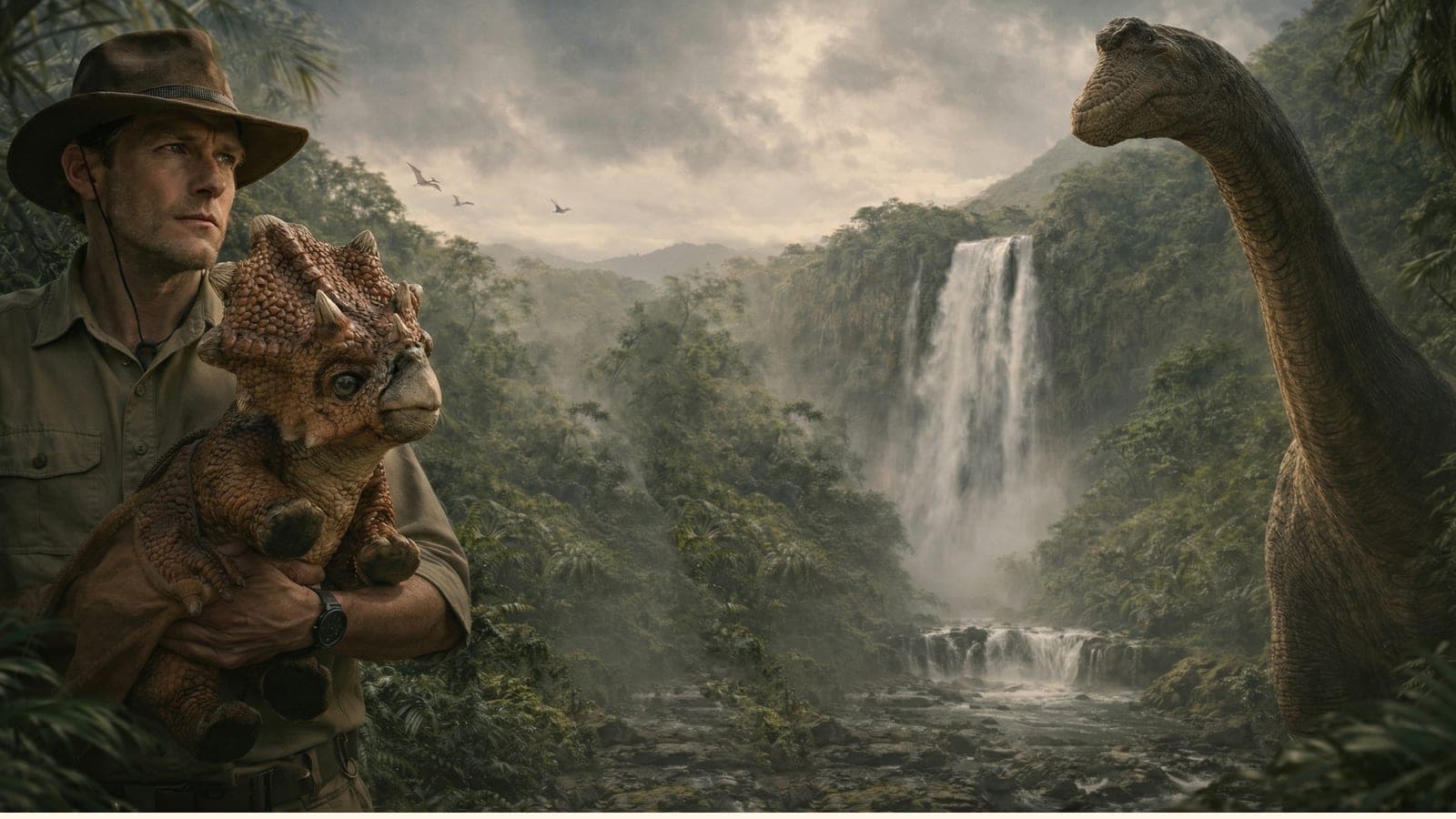
The baby Triceratops is one of the five puppets in our petting zoo (Basic) and one of two in our Premium event. The puppetry shows the proportions accurately — the wide frill, the developing horns (smaller on a baby than an adult), the bulky body. Kids can pet the frill and observe the body features the same way they would observe a modern animal at a zoo.
For schools and families curious about meeting the Triceratops, see the experience page.
Frequently asked questions#
How big was a baby Triceratops?#
Newly hatched Triceratops were about the size of a cat. They grew quickly, reaching elephant size in about 15 to 20 years. The babies at our mobile experience are scaled to the size of a young Triceratops (a few years old) — large enough for kids to interact with safely.
Did Triceratops live in herds?#
Almost certainly yes, at least some of the time. Bone bed deposits with multiple Triceratops fossils together suggest group behavior. Modern herbivores of similar size (elephants, bison) are also social. The exact social structure is debated.
Were the horns made of bone?#
Bone core covered in keratin. Like modern rhinos, the keratin sheath made the horns even longer and sharper in life than the fossil bone alone suggests. Keratin does not preserve, so the fossilized horns we see are shorter than the actual living horns were.
What's the difference between Triceratops and Torosaurus?#
Torosaurus is another ceratopsian with three horns and a frill — the frill is even larger than Triceratops's, with two holes in it. For a long time it was thought to be a separate species. Some paleontologists now argue that Torosaurus fossils may actually be very old adult Triceratops — that the frill changes shape with age. This debate is unresolved. Current consensus leans toward "probably separate species" but is not unanimous.
Did Triceratops have feathers?#
No fossil evidence of feathers on Triceratops. As a ceratopsian (a distantly related branch from the feathered theropods), Triceratops was almost certainly fully scaly.
When did Triceratops go extinct?#
About 66 million years ago, in the same Cretaceous-Paleogene extinction event that killed T-Rex and most other dinosaurs. Triceratops was one of the last dinosaur species alive on Earth before the asteroid impact. Full story in why did dinosaurs go extinct.
Meet a Triceratops up close#
Triceratops in a museum is impressive. Meeting a baby Triceratops up close — at our mobile experience for South Florida schools, daycares, and birthdays — gives kids the chance to actually look at the frill, the horns, and the body features they have only seen in books and movies. See the experience page or book your event.
See the dinosaurs you just learned about — up close
Jurassic Petting Zoo brings life-sized animatronic baby dinosaurs to schools, daycares, and birthdays across South Florida. The same dinosaurs you just read about, in your space.